Diode laser hair removal: comparison with pulsed light and medical lasers
Diode laser, pulsed light, Alexandrite laser, Nd-YAG… It’s hard to make sense of all the hair removal technologies on the market. Today, diode laser is one of the most widely used technologies in hair removal centers. But is it really the most effective? What are the differences with pulsed light or medical lasers? Here’s a full comparison to help you make the right choice.
What is diode laser hair removal?
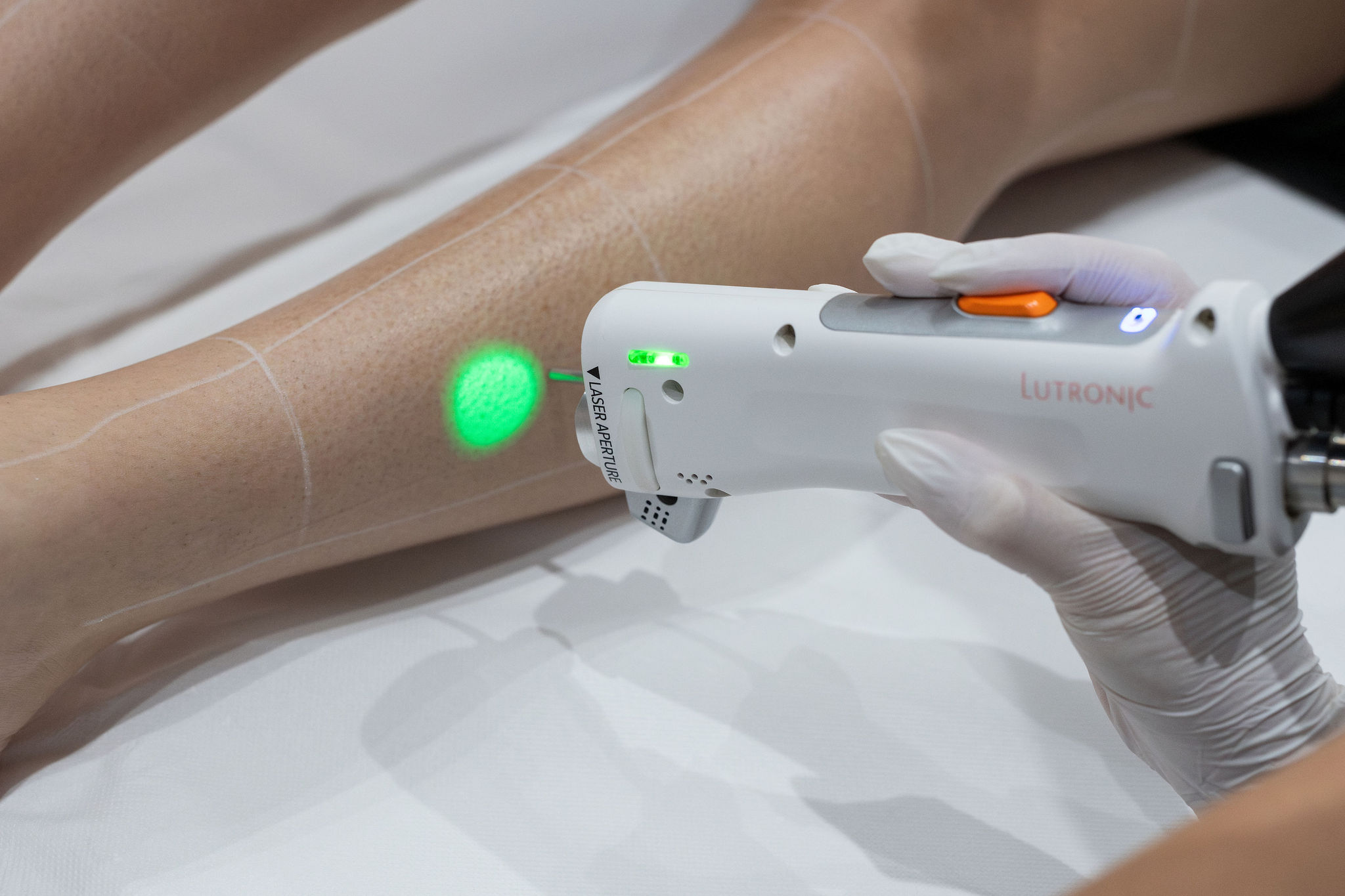
The diode laser is a monochromatic laser that emits light at a single wavelength of 808 nm (nanometers). This wavelength lies between that of the Alexandrite laser (755 nm) and the Nd-YAG laser (1064 nm).
The principle is the same as for all depilatory lasers: the light targets the melanin contained in the hair, transforming the energy into heat and destroying the hair bulb. This is known as selective photothermolysis.
The diode laser is often presented as a “compromise” between the two medical wavelengths. In reality, this compromise has its limits.
💡 Laser diode: advantages and disadvantages
Advantages: affordable technology, generally less expensive sessions, widespread in many centers.
Disadvantages: less effective on very fair skin (phototypes I-II) and dark skin (phototypes V-VI), less suitable for fine hair, results often inferior to specialized medical lasers.
Diode laser vs. Intense Pulsed Light (IPL): what are the differences?
Intense pulsed light (IPL) is not a laser. It’s a flash lamp that emits a broad spectrum of light (several wavelengths simultaneously, generally between 500 and 1200 nm).
Key differences
- Precision: diode laser emits targeted, concentrated light, IPL diffuse light
- Effectiveness: diode laser penetrates deeper and destroys the hair bulb better
- Number of sessions: IPL generally requires more sessions for less lasting results.
- Safety on dark skins: both technologies present risks on high phototypes
In short, the diode laser is more effective than pulsed light, but is limited by its single wavelength, which is not suitable for all profiles.
⚠️ Beware of beauty salons
Intense pulsed light (IPL) is permitted in beauty salons, as it is considered less powerful. Laser treatment, on the other hand, is subject to medical supervision. Beware of beauty salons that use the term “laser” to designate pulsed light.
Diode laser vs. Alexandrite laser vs. Nd-YAG laser
Alexandrite (755 nm) and Nd-YAG (1064 nm) lasers are the two benchmarks for medical laser hair removal. Each has its own specific features:
Alexandrite laser (755 nm)
- Ideal for phototypes I to III (light to light-dark skins)
- Highly effective on fine to medium hair
- Maximum absorption by hair melanin
- Not recommended for tanned or dark skin (risk of burning).
Nd-YAG laser (1064 nm)
- Ideal for phototypes IV to VI (darker skins)
- Penetrates deeper into the skin
- Preserves melanin-rich skin
- Can be used on lightly tanned skin
Laser diode (808 nm)
- Compromise between the two wavelengths
- Suitable for phototypes II to IV
- Less effective at extremes (very light or very dark skin)
- Less effective on fine hair
🔬 Why wavelength matters
Each wavelength penetrates the skin differently, targeting melanin with varying effectiveness. A wavelength adapted to your phototype guarantees better efficacy and fewer risks. That’s why centers equipped with several wavelengths achieve better results.
Comparison table: IPL vs Diode Laser vs Medical Laser
Here’s a summary of the three technologies to help you compare:
| Criteria | Intense Pulsed Light (IPL) | Diode laser | Alexandrite + Nd-YAG laser |
|---|---|---|---|
| Technology | Flash lamp (500-1200 nm) | 808 nm laser | Dual laser (755 nm + 1064 nm) |
| Precision | Diffuse | Targeted | Highly targeted and adaptable |
| Efficiency | Average | Good | High |
| Adapted phototypes | I to III | II to IV | I to VI (all) |
| Dark skins | Risky | Limited | Suitable (Nd-YAG) |
| Fine hairs | Not very effective | Not very effective | More effective (Alexandrite) |
| Sessions required | Numerous (10-15+) | Medium (8-12) | Fewer (6-10) |
| Durability of results | Low | Medium | High (80-95%) |
| Management | Beauty salon | Institute or specialized center | Medical (tele-expertise mandatory) |
Why does CtrlZ use dual wavelengths?
At CtrlZ, we have chosen to equip all our centers with dual-wavelength lasers : Alexandrite (755 nm) and Nd-YAG (1064 nm).
This technological choice allows :
- Tailor the treatment to each patient: the practitioner selects the wavelength according to your phototype
- Treat all skin types: from the fairest (phototype I) to the darkest (phototype VI)
- Optimize efficiency: each zone receives the most suitable wavelength
- Reduce risks: less risk of burns or pigment spots
Unlike diode lasers, which offer a one-size-fits-all compromise, our approach enables complete treatment customization.
✓ Medical support CtrlZ
- Systematic medical tele-expertise before any treatment
- Initial laser test to assess your skin’s reaction
- Settings adapted to each zone and your phototype
- 24/7 medical hotline in the event of an adverse reaction
Diode laser hair removal: frequently asked questions
Is diode laser hair removal permanent?
No laser hair removal technique can be described as “100% permanent”. Diode lasers provide long-lasting hair reduction, but results are generally inferior to those of Alexandrite and Nd-YAG lasers. Maintenance sessions are often required.
Is diode laser hair removal painful?
The sensation varies from person to person and from area to area. Diode lasers generally cause a tingling sensation comparable to “rubber band blows”. Lasers equipped with cooling systems (pulsed cold air) significantly reduce discomfort.
How many sessions can I expect with a diode laser?
Diode lasers require an average of 8 to 12 sessions, sometimes more depending on the area and hair density. This is generally more than Alexandrite/Nd-YAG medical lasers (6 to 10 sessions on average).
Are diode lasers dangerous?
Like all hair-removal lasers, diode lasers present risks if used incorrectly: burns, pigment spots, skin reactions. These risks are heightened on tanned or dark skin. Medical supervision and prior testing reduce these risks.
Diode laser or Alexandrite laser: which to choose?
If you have fair to light-dark skin (phototypes I to III), the Alexandrite laser will be more effective than the diode laser. For darker skins, Nd-YAG is preferable. The diode laser remains an acceptable compromise for intermediate phototypes (II to IV).
💡 Our recommendation
Rather than choosing between a diode laser and an Alexandrite laser, opt for a center that offers both wavelengths (Alexandrite 755 nm and Nd-YAG 1064 nm). It’s the guarantee of a treatment tailored to your skin, whatever your skin tone.
Ready to switch to medical lasers?
Still deciding between diode laser and medical laser? At CtrlZ, we offer you a free information consultation. Our team assesses your phototype, performs a laser test and advises you on the technology best suited to your skin.
Make an appointment at your nearest CtrlZ center.